
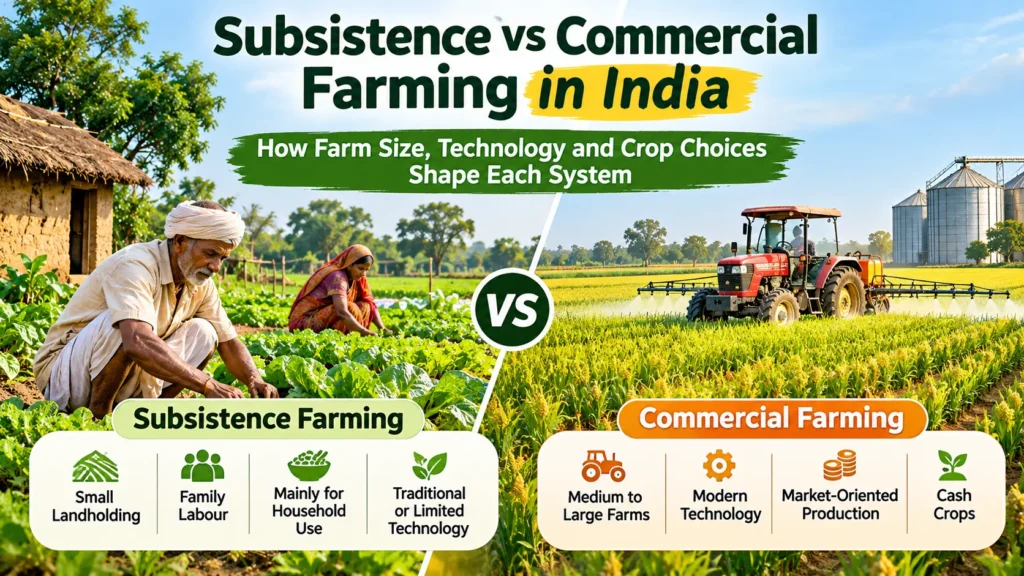
Agriculture plays an important role in India’s economy and provides livelihoods to millions of people. Across the country, farmers follow different agricultural practices depending on their land availability, financial resources, climatic conditions, and market requirements. Two major types of farming practiced in India are subsistence farming and commercial farming.
Subsistence farming is all about producing food for the farmer’s own family, whereas commercial farming is about growing crops and rearing livestock for sale in the market. Both are forms of farming which, in their own way, contribute to the development of agriculture and the food supply in India.
Understanding the difference between subsistence and commercial farming goes a long way to explaining how the nature of farming in the country is shaped by the level of production, the technology employed, the amount of labor required, and the level of market demand.
What Is Subsistence Farming?
Subsistence farming is a type of agriculture in which farmers grow crops and raise livestock primarily to meet their household food requirements. Production is generally intended for family consumption, although farmers may sell surplus produce in local markets.
This farming system is commonly associated with small and marginal landholdings, where family members contribute a significant portion of the agricultural labor.
In India, subsistence farming is practiced in different regions, particularly where farmers depend on agriculture for their household food security.
Characteristics of Subsistence Farming
- Land: Farming is generally on very small holdings.
- Family Labour: Family members do the sowing, the harvesting, and the livestock work.
- Limited Market Production: Most of the produce is used for household consumption, with surplus sold locally.
- Dependence on Natural Conditions: Rainfall, soil fertility, and climatic conditions influence agricultural production.
- Traditional Practices: Some farmers rely on traditional tools, indigenous knowledge and locally adapted farming methods.
Types of Subsistence Farming in India
Subsistence farming can broadly be divided into two categories:
-
Primitive Subsistence Farming
Primitive subsistence farming is practiced on small patches of land using simple tools and family or community labor. It is often dependent on monsoon rainfall and the natural fertility of the soil.
Shifting cultivation, also known as slash-and-burn agriculture, is one form of primitive subsistence farming.
In different parts of India, this practice is known by different names:
- Jhumming in parts of Northeast India.
- Pamlou in Manipur.
- Dipa in the Bastar region of Chhattisgarh.
-
INTENSIVE SUBSISTENCE FARMING
Intensive subsistence farming is practiced in areas where population pressure on agricultural land is high. Farmers use available land intensively to obtain maximum production from relatively small holdings.
This system involves considerable labor and may use irrigation, improved seeds, fertilizers, and other agricultural inputs to increase productivity.
It is commonly associated with densely populated agricultural regions where farmers depend heavily on limited land resources.
What Is Commercial Farming?
Commercial farming is an agricultural system in which crops and livestock are produced primarily for sale in domestic or international markets.
Unlike subsistence farming, the main objective of commercial agriculture is to generate income and profit through agricultural production.
Commercial farming often involves greater investment in agricultural machinery, improved seeds, irrigation facilities, fertilizers, pesticides, and other modern farming technologies.
In India, commercial agriculture is practiced across different states, depending on crop suitability, market demand, and available infrastructure.
Characteristics of Commercial Farming
- Market-oriented production: Crops and livestock are primarily produced for sale.
- Use of modern technology: Machinery, improved seeds, irrigation systems, and other technologies may be used to increase productivity.
- Higher capital investment: Farmers generally invest in agricultural inputs, equipment, and infrastructure.
- Large-scale production: Commercial farming may involve medium-sized or large agricultural operations, although small farms can also produce commercially.
- Market connectivity: Storage facilities, transportation, processing units, and agricultural markets play important roles.
- Specialized crop production: Farmers may focus on specific crops according to market demand and regional suitability.
Types of Commercial Farming in India
- Commercial Grain Farming
Commercial grain farming involves cultivating cereal crops primarily for sale in agricultural markets.
Wheat, rice and maize are important examples. These crops are produced commercially in several agricultural regions of India.
- Plantation Agriculture
Plantation agriculture is a form of commercial farming in which a single crop is cultivated over a large area, generally with considerable capital investment and organized labor.
Important plantation crops in India include:
- Tea in Assam and West Bengal.
- Coffee in Karnataka and Kerala.
- Rubber in Kerala and other suitable regions.
- Sugarcane in Uttar Pradesh and Maharashtra.
Plantation agriculture also has strong connections with processing industries because agricultural produce is often used as industrial raw material.
- Commercial Horticulture
Commercial horticulture is the growing of fruit, vegetables, flowers and ornamentals for sale.
Examples include mangoes, grapes, floriculture and commercial vegetable production.
This farming system supplies fresh produce to local markets, supermarkets, food-processing industries and export markets.
Examples of Subsistence and Commercial Farming in India
India’s geographical diversity allows different farming systems to exist across states and regions.
Examples of Subsistence Farming
Household rice cultivation in parts of Odisha (where production is likely to be mainly for household consumption).
Small-scale mixed crop cultivation in the rural areas (cereals, pulses and vegetables for home consumption).
Shifting cultivation in parts of Northeast India, where agricultural production is traditionally intended to support local communities.
Examples of Commercial Farming
- Tea plantations in Assam (where the tea leaves are grown for processing and sale).
- Coffee plantations in Karnataka (which supply both the domestic and international markets).
- Commercial cotton cultivation in Gujarat and Maharashtra.
- Commercial sugarcane cultivation in Uttar Pradesh and Maharashtra.
- Commercial rice cultivation in Punjab and Haryana.
An important point to understand is that the same crop can be cultivated under different farming systems. For example, rice may be grown primarily for household consumption in one region and as a commercial crop in another. The purpose of cultivation and the extent of market-oriented production determine its classification.
Advantages of Subsistence Farming
Subsistence farming continues to play an important role in rural livelihoods and household food security.
Some of its major advantages include:
- Household Food Security: Farmers produce food for their families, reducing dependence on purchasing all their food requirements.
- Use of Local Resources: Traditional farming practices often rely on locally available seeds, knowledge, and agricultural resources.
- Crop Diversity: Farmers may cultivate different crops to meet various household nutritional requirements.
- Livelihood Support: It provides employment and sustenance for farming households.
- Preservation of Traditional Knowledge: Indigenous agricultural practices and locally adapted crop varieties can be maintained through traditional farming systems.
Advantages of Commercial Farming
Commercial farming leads to agricultural trade, industrial development, and economic activity.
Its major advantages include:
- Income Generation: Farmers get their income by selling their produce.
- Higher Production Potential: Improved seeds, irrigation, and modern machinery can increase agricultural productivity.
- Industrial Development: Commercial crops provide raw materials to food-processing, textile, sugar, and other industries.
- Employment Opportunities: Agricultural operations provide employment in cultivation, harvesting, processing, packaging, and transport.
- Market Expansion: Agricultural products can be sold in both domestic and international markets.
Challenges Faced by Both Farming Systems
- Water Scarcity: Due to erratic rainfall, depletion of groundwater, and limited irrigation facilities can have an impact on agricultural output.
- Climate Change: Rising temperatures, changing rainfall patterns, droughts, and floods can damage crops and reduce yields.
- Rising Input Costs: Seeds, fertilizer, pesticides, machinery, labor, etc, will, of course, increase the cost of cultivation.
- Limited Market Access: Farmers will find it very difficult to get access to reliable markets, storage, and transport.
- Land Fragmentation: The division of land over successive generations can lead to smaller, less viable holdings from an economic point of view.
- Price Volatility: Changes in the prices of agricultural commodities can have a significant impact on the incomes of farmers, especially those growing crops for commercial purposes.
Role of Modern Technology in Indian Agriculture
Modern agricultural technologies are helping farmers improve production, manage resources, and respond to changing agricultural requirements.
Some important developments include:
- Drip Irrigation: Delivers water directly to plant roots, helping improve water-use efficiency.
- Agricultural Mechanisation: Tractors, harvesters, and other machinery help reduce manual labor and improve operational efficiency.
- Precision Agriculture: Uses GPS, sensors, satellite imagery, and data analysis to support better farm management.
- High Yielding Varieties: Improved crop varieties can help increase productivity under suitable growing conditions.
- Digital Agricultural Platforms: mobile apps and online platforms provide information on the weather, the markets, and crop management.
Conclusion
Subsistence and commercial farming are two important agricultural systems that contribute to India’s rural economy and food production. While subsistence farming primarily supports household consumption and livelihood requirements, commercial farming focuses on producing agricultural goods for domestic and international markets.
Both systems have their pros and cons. Subsistence farming provides for household food security and maintains traditional farming methods, whilst commercial farming provides a source of income, underpins the industrial sector, and enables participation in agricultural trade.
With the right technologies, improved infrastructure and sustainable farming practices in place, both farming systems can make a contribution to a more productive and resilient agricultural sector in India.