
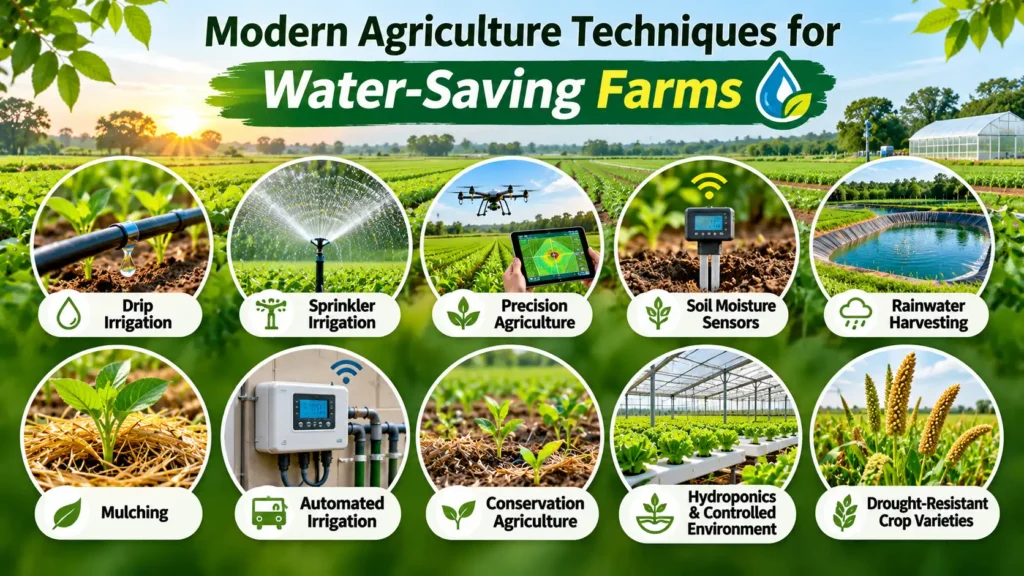
Modern Agricultural Techniques for Water-Saving Farms
Water is one of the most important resources required for agricultural production. However, increasing water scarcity, irregular rainfall, climate change, and rising agricultural demand have made water conservation a major priority for farmers worldwide. Traditional irrigation methods often result in water loss through evaporation, surface runoff, and excessive application.
Modern agriculture has a wide range of practical ways of improving water use efficiency without any reduction in crop yield. These include drip irrigation, precision farming, soil moisture sensors, rainwater harvesting, and automated irrigation systems.
Water-saving agriculture is about getting the right amount of water to the crop at the right time. It’s about reducing the amount of water that’s wasted through poor management and, in doing so, improving soil health and building more sustainable farming systems.
Drip Irrigation
Drip irrigation is one of the most efficient water-saving techniques in modern agriculture and involves the delivery of water directly to the root zone of the plant via a network of pipes, tubes, and emitters.
Unlike conventional flood irrigation (water being applied over the whole field), drip irrigation applies water in measured quantities. This in itself reduces the amount of water lost through evaporation and surface runoff.
Benefits of drip irrigation:
- Reduces unnecessary water wastage.
- Delivers moisture directly to the plant roots.
- Helps to maintain a consistent level of soil moisture.
- Reduces weed growth in between crop rows.
- Allows fertilizer to be applied via irrigation (fertigation).
Drip irrigation is ideal for vegetables, fruit, sugarcane, and plantation crops.
Sprinkler Irrigation
Sprinkler irrigation is another modern technique that helps farmers manage water more efficiently. It distributes water through pipes and sprinkler heads, which spray water over crops in a manner similar to natural rainfall.
This method is suitable for different types of agricultural fields, including areas where surface irrigation is difficult.
Benefits of sprinkler irrigation:
- Provides relatively uniform water distribution when properly designed.
- Reduces water loss compared with some conventional surface irrigation methods.
- Suitable for a variety of crops and soil types.
- Helps irrigate uneven or undulating land.
- Can be adapted for automated irrigation systems.
However, wind conditions, high temperatures, and poor sprinkler placement can all lead to increased evaporation losses.
Precision Agriculture
Precision agriculture is the use of modern technology and data to manage agriculture more precisely. It enables the farmer to understand the variation in soil, crop, and water requirements across the field.
GPS, satellite imagery, drones, GIS, and digital farm management platforms can all be used to monitor crop conditions and plan irrigation.
Benefits of precision agriculture:
- Helps to identify areas that need further irrigation.
- Reduces unnecessary water application.
- Improves farm resource management.
- Supports better crop monitoring.
- Helps farmers make informed irrigation decisions.
By using field-specific information, farmers can avoid applying the same quantity of water across areas with different moisture requirements.
Soil Moisture Sensors
Soil moisture sensors are modern agricultural devices that measure the amount of water present in the soil. They help farmers determine when crops need irrigation instead of relying entirely on fixed watering schedules.
These sensors can be installed at different soil depths to monitor moisture conditions around the plant root zone.
Some advanced systems can be connected to automated irrigation equipment, allowing irrigation to begin when soil moisture falls below a predetermined level.
This technology is especially useful in regions where water availability is limited.
Rainwater Harvesting
Rainwater harvesting is the collection and storage of rainwater for later use in agriculture. It is a key water conservation technique, particularly in areas where rainfall is erratic or where there are seasonal water shortages.
Farmers can collect rainwater from rooftops, agricultural buildings, and specially designed catchment areas. It can also be stored in farm ponds, tanks, and reservoirs.
Benefits of rainwater harvesting:
- Provides an additional source of irrigation water.
- Reduces dependence on groundwater.
- Helps to manage seasonal water shortages.
- Supports groundwater recharge where it’s properly designed.
- Reduces surface runoff and soil erosion in the appropriate systems.
Farm ponds and rainwater storage structures can be particularly valuable for small and marginal farmers.
Mulching
Mulching is an agricultural practice in which the soil surface is covered with materials such as straw, dry leaves, crop residues, or plastic films.
The covering reduces direct exposure of the soil to sunlight and wind, helping retain moisture for longer periods. It also reduces weed growth and can improve soil conditions.
There are two major types of mulching:
- ORGANIC MULCHING: Uses natural materials such as straw, leaves, grass clippings, and crop residues.
- INORGANIC MULCHING: Uses materials such as plastic films and synthetic sheets.
Benefits of mulching:
- Reduces moisture loss through evaporation.
- Helps regulate soil temperature.
- Suppresses weed growth.
- Protects soil from erosion.
- Organic mulches can improve soil organic matter as they decompose.
Automated Irrigation Systems
Automated irrigation systems use sensors, controllers, valves, and other equipment to regulate the supply of water to crops.
These systems can be programmed to operate according to crop water requirements, soil moisture levels, and weather conditions.
Smart irrigation systems may also use mobile applications and internet-connected devices to help farmers monitor and control irrigation remotely.
Benefits of automated irrigation:
- Reduces manual irrigation work.
- Helps prevent overwatering.
- Improves water distribution.
- Allows timely irrigation.
- Supports efficient farm management.
Automation is particularly useful for large farms and greenhouse operations, although smaller systems can also be designed for individual farmers.
Conservation Agriculture
Conservation agriculture is a farming approach that focuses on maintaining soil health, reducing soil disturbance, and protecting the soil surface.
It is based on three major principles:
- Minimum soil disturbance through reduced or zero tillage.
- Permanent soil cover using crop residues or cover crops.
- Crop diversification through crop rotation and intercropping.
These practices can improve soil structure, increase infiltration, and reduce surface runoff. They can also help retain soil moisture and reduce the frequency of irrigation required in certain farming conditions.
Conservation agriculture is especially useful in areas affected by soil degradation and irregular rainfall.
Hydroponics and Controlled Environment Agriculture
Hydroponics is a modern method of cultivation where the plant is grown without soil at all, with the roots being fed the nutrients and moisture they require via a carefully controlled system.
Many hydroponic systems are set up to recirculate the nutrient solution so that the water is reused rather than being continually discharged.
Controlled environment agriculture (greenhouse and vertical farming) can go even further in terms of water use by controlling temperature, humidity, and all the other growing conditions.
Drought Resistant Crop Varieties
Growing drought-resistant or drought-tolerant crop varieties is another important strategy for water-saving agriculture.
These varieties have been developed or selected to be better than the conventional varieties at putting up with periods of water stress. The traits they may have will vary from crop to crop but may include deeper root systems, shorter growing seasons, or better water use efficiency.
Farmers can also select crops that are naturally suited to local rainfall patterns and climatic conditions.
Examples include certain varieties of millets, sorghum, and pulses that can perform well under relatively dry conditions.
Importance of Water-Saving Agricultural Techniques
Adopting modern water-saving techniques offers several long-term advantages for agricultural sustainability.
- IMPROVED WATER USE EFFICIENCY: Modern irrigation technologies help deliver water according to crop requirements, reducing unnecessary consumption.
- BETTER CROP PRODUCTIVITY: Maintaining the right level of soil moisture will lead to healthier plants and better crop performance.
- REDUCED FARMING COSTS: Efficient irrigation can reduce water pumping requirements and energy costs (depending on the system).
- GROUNDWATER CONSERVATION: Reducing the level of groundwater extraction will help in the conservation of water for future agricultural use.
- CLIMATE RESILIENCE: Water-efficient farming practices will help the farmer cope with droughts, erratic rainfall, and changing climate.
- SUSTAINABLE SOIL MANAGEMENT: Mulching and conservation agriculture are techniques that help to protect soil structure and improve moisture retention.
Conclusion
Modern farming is all about the use of modern techniques to manage water. Drip irrigation, sprinkler irrigation, precision agriculture, soil moisture monitoring, rainwater harvesting, and conservation agriculture are all real-world techniques that can be used to reduce water waste.
As water scarcity becomes such an issue, the adoption of efficient irrigation and sustainable farming practices is absolutely critical to long term agricultural development. The right mix of traditional local knowledge and modern technology can make a massive difference in terms of productivity, consumption and resilience.
Water saving in agriculture isn’t simply about using less water. It’s about using every drop you have far more efficiently.
Frequently Asked Questions